
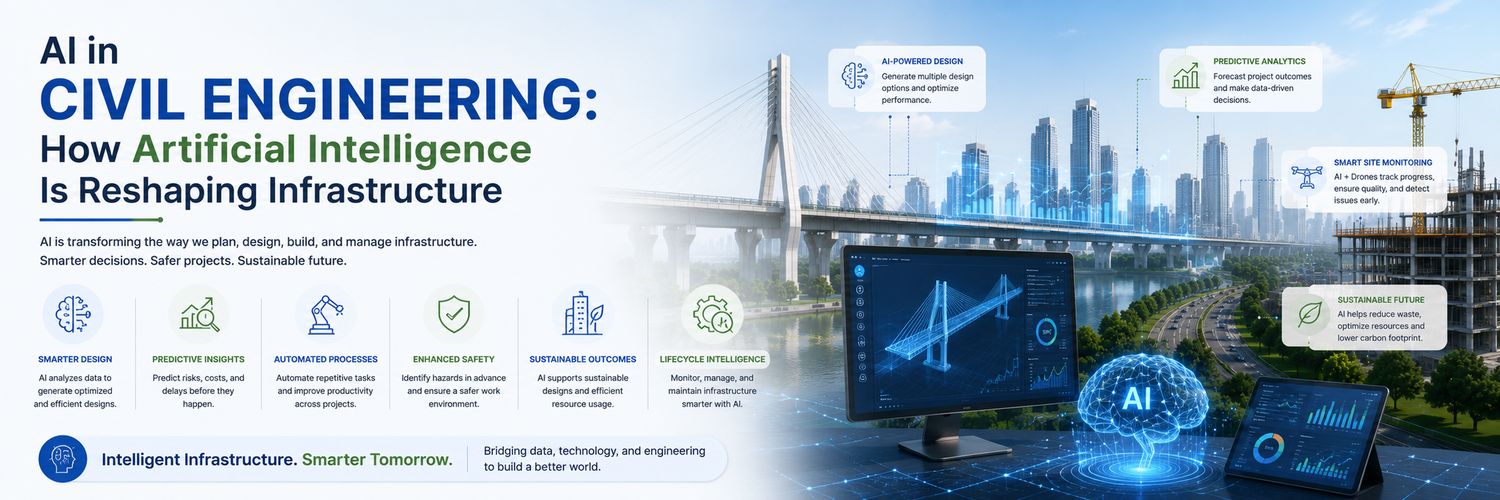
AI in Civil Engineering: How Artificial Intelligence Is Reshaping Infrastructure
Every few months, there's a new headline about artificial intelligence changing the way we work. Some people see AI as the future of every industry, while others worry it might replace jobs. In civil engineering, the reality is somewhere in between.
Artificial intelligence is not replacing engineers. It is helping them work more efficiently, analyse larger amounts of data, and make better-informed decisions. Engineering will always require human judgment, practical experience, and an understanding of how structures behave in the real world. AI simply adds another layer of capability.
The civil engineering industry has always embraced technology. We moved from hand drafting to CAD, from paper calculations to structural analysis software, and from 2D drawings to Building Information Modelling (BIM). Artificial intelligence is the next step in that evolution.
What Does AI Mean in Civil Engineering?
When people hear the term AI, they often think of robots or chatbots. In civil engineering, AI is much more practical.
It refers to computer systems that can analyse large volumes of information, recognise patterns, predict outcomes, and assist engineers in making decisions.
For example, AI can analyse years of traffic data to predict future congestion, identify structural defects from drone images, estimate construction schedules, or help optimise a building's design for lower material usage.
The engineer still makes the final decision. AI simply provides better insights based on available data.
Smarter Design Begins Before Construction
One of the biggest challenges in any infrastructure project is finding the most efficient design.
Traditionally, engineers evaluate several alternatives before selecting the best option. This process can take considerable time, especially on large projects.
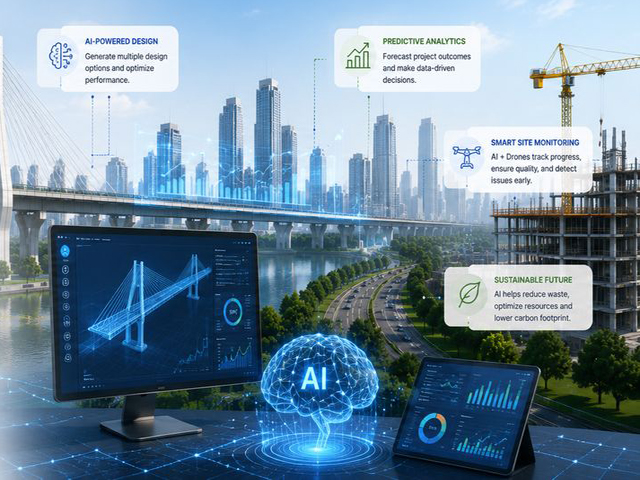
AI can analyse thousands of possible design combinations in a fraction of the time. It considers factors such as material quantities, structural performance, construction cost, and environmental impact to identify solutions worth exploring.
Instead of replacing engineering creativity, AI gives engineers more options to evaluate.
Predictive Maintenance Is Changing Asset Management
Infrastructure doesn't stop requiring attention once construction is complete.
Bridges, roads, pipelines, and buildings all need regular inspection and maintenance.
Traditionally, inspections are carried out on fixed schedules. While this approach works, it doesn't always identify problems before they become serious.
Artificial intelligence is helping infrastructure owners move toward predictive maintenance.
By analysing inspection reports, sensor data, and historical performance, AI can identify assets that are more likely to require attention before visible failures occur.
This allows maintenance teams to focus their efforts where they are needed most, reducing costs and improving public safety.
AI and Computer Vision
Drones have become common on construction sites.
They capture thousands of photographs during surveys, inspections, and progress monitoring.
Reviewing every image manually can take days.
AI-powered computer vision systems can quickly scan these images to identify cracks, corrosion, surface damage, construction progress, or safety concerns.
Rather than replacing site engineers, these tools help them review information more efficiently and prioritise detailed inspections where necessary.
Better Project Planning
Every construction project faces uncertainty.
Material delays, labour shortages, weather conditions, and design changes can all affect project schedules.
Artificial intelligence can analyse previous projects to identify patterns that influence delivery timelines.
Project managers can then make more informed decisions about scheduling, procurement, and resource allocation.
While AI cannot predict every challenge, it helps reduce uncertainty by learning from historical project data.
AI Supports Sustainable Infrastructure
Sustainability has become an important part of infrastructure planning.
Engineers are expected to reduce material consumption, minimise environmental impact, and improve long-term efficiency.
AI helps by evaluating multiple design alternatives and identifying options that reduce carbon emissions, optimise material use, or improve operational performance.
Even relatively small improvements during design can lead to significant environmental benefits over the life of an infrastructure asset.
AI Works Alongside BIM and Digital Twins
Artificial intelligence becomes even more powerful when combined with technologies such as Building Information Modelling (BIM) and Digital Twins.
A Digital Twin continuously collects information about a physical asset through sensors and monitoring systems.
AI can analyse this information to detect unusual behaviour, predict maintenance requirements, and recommend actions before problems become critical.
Instead of reacting after failures occur, infrastructure owners can take preventive action based on real-time data.
Will AI Replace Civil Engineers?
This is probably the most common question people ask.
The answer is no.
Engineering is much more than calculations.
It involves judgment, experience, communication, creativity, and responsibility. Engineers understand site conditions, construction challenges, design codes, client requirements, and public safety in ways that artificial intelligence cannot.
AI can process information quickly.
Engineers decide what that information means.
The future is not engineers versus AI.
It is engineers who know how to use AI working alongside those who do not.
Skills Engineers Should Start Learning
As AI becomes more common across the industry, engineers don't need to become data scientists.
However, they should become comfortable working with digital tools and AI-assisted workflows.
Some valuable skills include:
Building Information Modelling (BIM)
Data interpretation
Engineering software
GIS
Digital Twin technologies
Construction analytics
Automation workflows
Engineers who combine strong technical knowledge with digital skills will be better prepared for future infrastructure projects.
Final Thoughts
Artificial intelligence is not changing the fundamentals of civil engineering.
Structures still need to be safe. Roads still need to carry traffic. Water systems still need to deliver reliable service.
What AI is changing is the way engineers approach these challenges.
By reducing repetitive work, improving analysis, identifying hidden patterns, and supporting better decisions, AI allows engineers to spend more time solving problems and less time processing information.
As infrastructure becomes more connected and data-driven, artificial intelligence will become another essential tool in every engineer's toolbox.
The future of civil engineering will continue to be shaped by skilled professionals. AI will simply help them build better, faster, and smarter.