
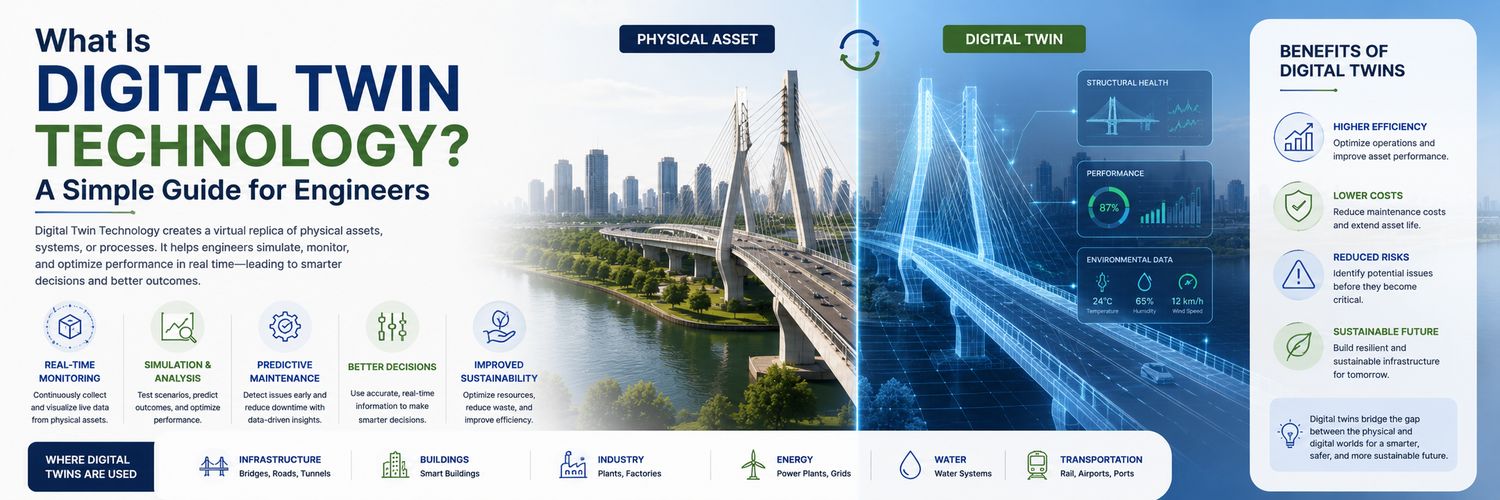
What Is Digital Twin Technology? A Simple Guide for Engineers
Over the last few years, "Digital Twin" has become one of the most talked-about terms in the engineering and infrastructure industry. You'll hear it in discussions about smart cities, airports, highways, railways, manufacturing plants, and even water distribution networks.
But what exactly is a Digital Twin?
Is it just another name for a 3D model?
Is it the same as Building Information Modelling (BIM)?
Or is it something entirely different?
The truth is, a Digital Twin is much more than a digital drawing or a 3D representation of an asset. It's a living digital model that evolves along with its physical counterpart.
Let's break it down in simple terms.
Understanding the Idea
Imagine you own a car.
You know how much fuel it has, when it needs servicing, how many kilometres it has travelled, and whether there's a warning light on the dashboard. That information helps you understand the current condition of your vehicle and decide when maintenance is required.
Now imagine having that same level of information for a bridge, a railway station, a water treatment plant, or an entire city.
That's the basic idea behind a Digital Twin.
A Digital Twin is a virtual representation of a physical asset that continuously receives data from the real world. Instead of remaining static like a traditional drawing, it updates as conditions change.
This allows engineers and asset owners to monitor performance, detect potential problems, and make better decisions throughout the asset's lifecycle.
It Starts Long Before Construction
Many people assume Digital Twins are created after a project is completed.
In reality, the process often begins during planning and design.
Engineers develop detailed digital models while designing a project. These models include information about geometry, materials, equipment, dimensions, and construction details.
As construction progresses, the digital model is updated to reflect what is actually being built.
Once the project becomes operational, sensors, monitoring systems, and inspection data begin feeding information back into the model.
The Digital Twin continues to evolve for years after construction ends.
More Than Just a 3D Model
One of the biggest misconceptions is that every 3D model is a Digital Twin.
It isn't.
A 3D model shows what something looks like.
A Digital Twin shows how it behaves.
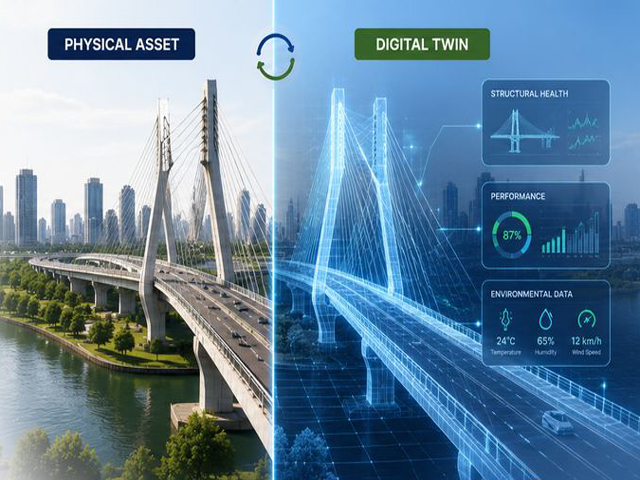
For example, a bridge's Digital Twin can display traffic loads, structural movement, temperature changes, inspection history, maintenance records, and sensor readings.
Instead of simply viewing the bridge, engineers can understand how it's performing in real time.
That difference is what makes Digital Twins so valuable.
Why Are Infrastructure Owners Investing in Digital Twins?
Infrastructure assets are expected to last for decades.
During that time, they require regular inspections, maintenance, repairs, and upgrades.
Traditionally, much of this information was stored in separate reports, spreadsheets, drawings, and maintenance records.
Finding the right information often meant searching through multiple systems.
Digital Twins bring all this information together in one place.
Engineers can quickly understand the history of an asset, identify recurring problems, and make better maintenance decisions.
This not only saves time but also improves the quality of decision-making.
Applications Across Different Sectors
Digital Twin technology isn't limited to one branch of engineering.
Its applications continue to grow across multiple industries.
Transportation
Highway authorities can monitor traffic conditions, pavement performance, bridges, tunnels, and roadside assets using Digital Twins.
Instead of waiting for problems to become serious, maintenance can be planned proactively.
Water Utilities
Water distribution networks are becoming increasingly intelligent.
Digital Twins help utilities monitor pressure, flow rates, leakage, reservoir levels, and pumping stations.
By combining real-time data with hydraulic models, operators can respond quickly to changing conditions and improve network performance.
Buildings
Large commercial buildings and hospitals use Digital Twins to monitor energy consumption, air conditioning systems, lighting, occupancy, and equipment performance.
Facility managers gain better visibility into daily operations and can identify opportunities to improve efficiency.
Railways
Rail operators use Digital Twins to monitor tracks, stations, signalling systems, bridges, and rolling stock.
Continuous monitoring helps improve reliability while reducing unexpected maintenance issues.
Predicting Problems Before They Happen
One of the biggest advantages of Digital Twin technology is predictive maintenance.
Imagine a bridge equipped with sensors that measure vibration and movement.
If those readings begin changing over time, engineers receive early warnings that something may require attention.
The bridge isn't repaired because it has already failed.
It's repaired before failure occurs.
This approach improves safety while reducing maintenance costs.
The same principle applies to water pipelines, industrial equipment, buildings, and transportation infrastructure.
Supporting Smarter Cities
Cities generate enormous amounts of information every day.
Traffic movement, water supply, electricity consumption, drainage systems, public transport, and environmental monitoring all produce valuable data.
Digital Twins bring these systems together.
Instead of making decisions using isolated information, city planners can understand how different systems interact with one another.
This helps improve planning, emergency response, infrastructure investments, and long-term urban development.
Digital Twins and Artificial Intelligence
Digital Twins become even more powerful when combined with artificial intelligence.
AI can analyse the data collected by the Digital Twin, identify patterns, predict future performance, and recommend maintenance activities.
Instead of simply displaying information, the system begins helping engineers understand what that information means.
The engineer still makes the final decision, but AI provides valuable insights that would be difficult to identify manually.
Challenges to Adoption
Despite their advantages, Digital Twins are not implemented overnight.
Creating one requires accurate engineering data, reliable sensors, good asset information, and proper digital workflows.
Organisations also need trained professionals who understand how to manage and interpret the information.
Like any technology, a Digital Twin is only as useful as the quality of the data it receives.
The Future of Infrastructure
As infrastructure becomes more connected, Digital Twins are expected to become a standard part of asset management.
Governments, transportation authorities, utility companies, airports, and industrial organisations are increasingly investing in digital technologies to improve efficiency and extend the life of their assets.
The goal isn't simply to create impressive digital models.
The goal is to make better engineering decisions throughout the entire lifecycle of an asset.
Final Thoughts
Digital Twin technology represents a major shift in the way infrastructure is managed.
Instead of relying only on drawings, inspection reports, and periodic maintenance, engineers now have access to living digital models that reflect what's happening in the real world.
That leads to better planning, faster maintenance, improved safety, and more informed decision-making.
As engineering continues moving toward data-driven workflows, Digital Twins will play an increasingly important role across every sector of infrastructure.
For engineers, understanding this technology isn't just about keeping up with industry trends. It's about preparing for the way infrastructure will be designed, managed, and maintained in the years ahead.