
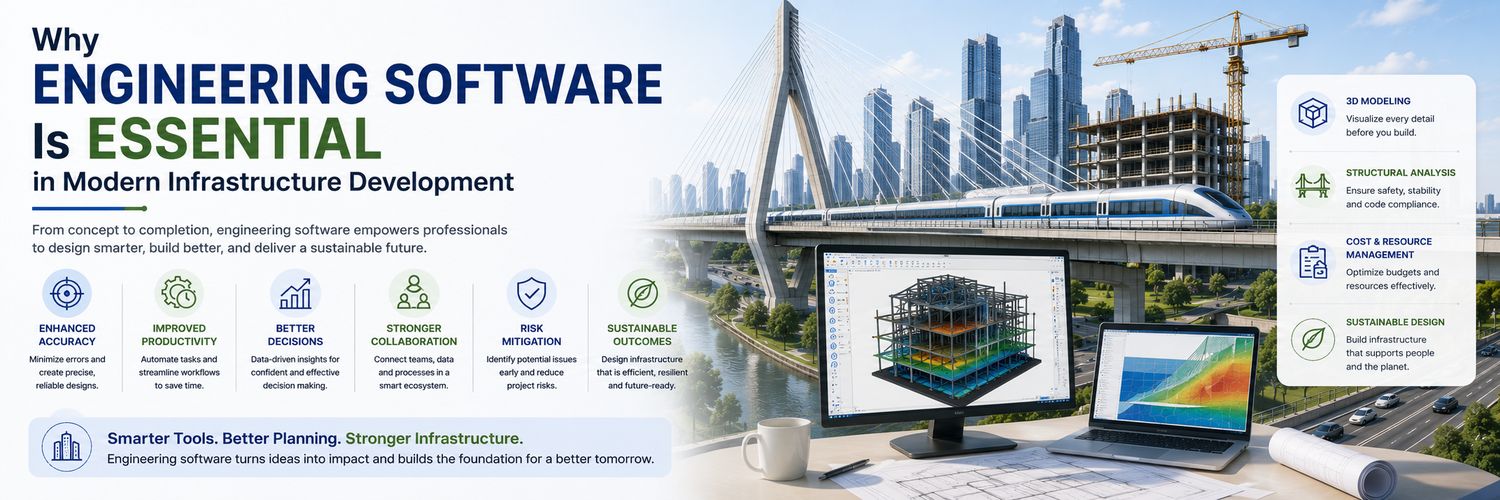
Why Engineering Software Is Essential in Modern Infrastructure Development
Every time we drive on a highway, cross a bridge, or turn on a tap at home, we're using infrastructure that someone carefully planned, designed, and built. Most people only see the finished project. What they don't see are the countless hours of engineering that happen long before construction begins.
Behind every successful project is a long list of decisions. How much load will the bridge carry? Will the foundation remain stable during heavy rainfall? Can the water supply network still meet demand twenty years from now? Is the drainage system capable of handling extreme weather?
These aren't questions that engineers can afford to guess. Every answer needs to be backed by calculations, analysis, and careful planning.
That's exactly why engineering software has become such an important part of modern infrastructure development.
Engineering Has Changed. So Have the Tools.
If you speak to engineers who have been in the industry for thirty or forty years, they'll often tell you stories about working with drafting boards, log tables, hand calculations, and stacks of design sheets. Those methods built some remarkable projects, and the engineering principles behind them are still just as relevant today.
What has changed is the scale of the work.
Cities are expanding faster than ever. Infrastructure projects cover larger areas, involve more stakeholders, and must comply with stricter safety and environmental standards. At the same time, clients expect projects to be completed faster and within tighter budgets.
An engineer working on a highway today isn't just designing pavement. They're coordinating with drainage experts, utility planners, survey teams, environmental consultants, structural engineers, and government authorities.
Managing all of that manually simply isn't practical anymore.
It Isn't About Replacing Engineers
One of the biggest misconceptions about engineering software is that it does the engineer's job.
It doesn't.
Software doesn't know whether a bridge is being built in the Himalayas or along the coast. It doesn't understand the challenges of poor soil conditions or the practical difficulties of construction on a busy urban site.
Those decisions still come from engineers.
Think of engineering software as a very powerful calculator. It can analyse thousands of variables in minutes instead of days. It speeds up the work, but it still relies on the engineer to provide the right inputs and, more importantly, to question the results when something doesn't look right.
Good engineers don't trust software blindly. They use it to validate their thinking, explore different options, and make more informed decisions.
Small Mistakes Can Become Expensive Problems
Infrastructure projects leave very little room for error.
A minor mistake during design can quickly become a major issue once construction begins.
Imagine discovering halfway through a bridge project that a member has been under-designed. Or realising after a water supply system has been installed that certain areas won't receive enough pressure during peak demand.
By that stage, correcting the problem usually means additional time, additional money, and unnecessary delays.
Engineering software helps identify these issues long before they reach the construction site.
Instead of waiting until something goes wrong, engineers can simulate different conditions, test alternative designs, and identify weak points while changes are still easy to make.
That is one of the biggest reasons digital design has become the industry standard.
Seeing Problems Before They Exist
One of the most valuable features of modern engineering software is its ability to answer "what if" questions.
What happens if traffic volume doubles over the next twenty years?
What if rainfall exceeds historical records?
What if a building experiences seismic loading?
What if groundwater levels change?
Instead of relying on assumptions, engineers can model these situations and understand how their designs are likely to perform.
This doesn't just improve safety. It gives project owners greater confidence that the infrastructure they're investing in will continue performing well for decades.
Better Collaboration Leads to Better Projects
Infrastructure is rarely designed by one person.
A metro station may involve architects, structural engineers, electrical engineers, mechanical consultants, geotechnical experts, utility planners, and contractors.
Every team depends on information produced by someone else.
Without proper coordination, even a small design change can create problems throughout the project.
Modern engineering platforms make collaboration much easier by allowing teams to work with shared project information instead of isolated drawings and spreadsheets.
Everyone works from the same data. That reduces confusion, avoids unnecessary rework, and helps projects move forward more efficiently.
Engineering Is Becoming More Visual
Not everyone involved in a project understands engineering drawings.
Clients, government officials, investors, and even local communities often need to understand what is being proposed before construction begins.
Three-dimensional models have changed the way engineers communicate.
Instead of explaining hundreds of drawings, engineers can now walk stakeholders through a digital representation of the project.
People can see how a bridge will fit into the surrounding landscape, how a road alignment will affect nearby communities, or how a treatment plant will operate long before construction starts.
Better communication usually leads to better decisions.
Sustainability Starts During Design
When people talk about sustainable infrastructure, they often focus on renewable energy or environmentally friendly materials.
But sustainability begins much earlier.
It starts during the design process.
A better structural design can reduce steel consumption. An optimised water network can lower pumping costs for decades. A carefully planned road alignment can minimise excavation and reduce environmental impact.
Engineering software gives designers the opportunity to compare multiple options instead of settling for the first solution.
Sometimes a small improvement on paper results in significant savings throughout the life of a project.
Preparing Engineers for a Digital Future
Today's engineering graduates enter a profession that looks very different from it did twenty years ago.
Employers still expect strong technical knowledge, but they're also looking for engineers who are comfortable working with digital tools, analysing data, and collaborating within modern design environments.
Understanding software has become just as important as understanding engineering fundamentals.
That doesn't mean software replaces technical knowledge.
In fact, the opposite is true.
The more experienced an engineer becomes, the more effectively they can use software to solve complex problems.
Looking Ahead
The future of infrastructure isn't just about building more roads, bridges, or water treatment plants.
It's about building them smarter.
Technologies such as Building Information Modelling (BIM), Geographic Information Systems (GIS), Digital Twins, automation, and artificial intelligence are already changing the way infrastructure is planned, constructed, and managed.
At the centre of all these innovations is engineering software.
It is no longer just another tool on an engineer's computer. It has become an essential part of delivering infrastructure that is safer, more efficient, and better prepared for the challenges of tomorrow.
Final Thoughts
Good engineering has never been about drawing lines or running calculations. It has always been about solving problems that improve people's lives.
Engineering software doesn't change that goal.
What it changes is the way engineers approach those problems. It gives them better information, faster analysis, clearer communication, and the confidence to make decisions based on data rather than assumptions.
As infrastructure projects continue to grow in size and complexity, one thing is becoming increasingly clear. Engineering expertise will always remain at the heart of every successful project, but modern engineering is no longer possible without the right digital tools.