
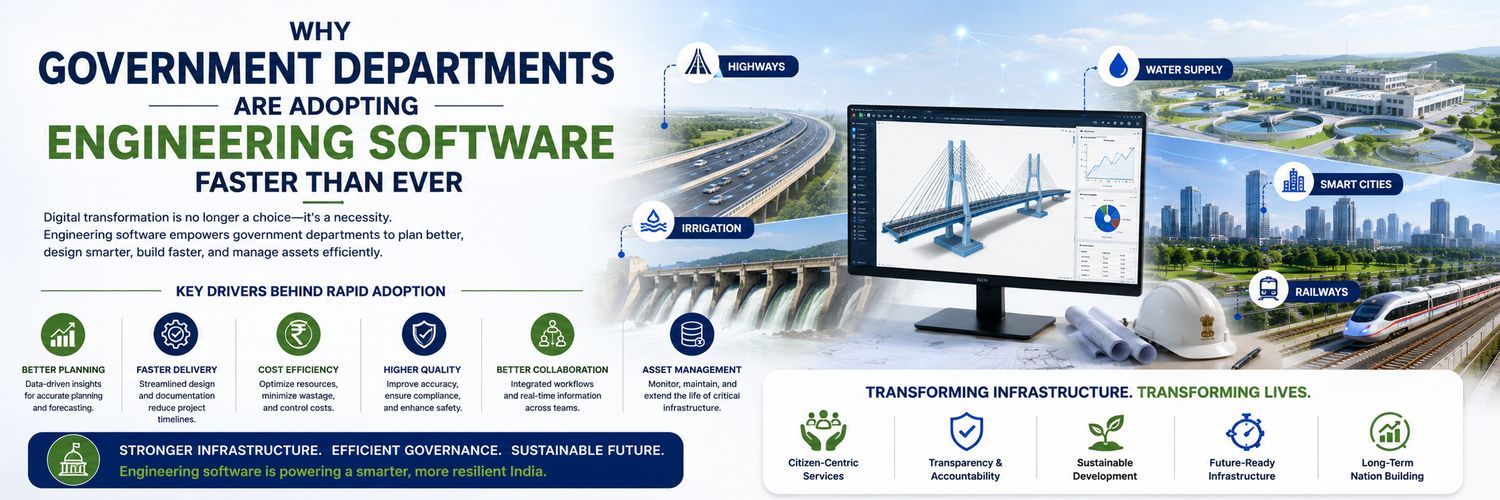
Why Government Departments Are Adopting Engineering Software Faster Than Ever
There was a time when most government infrastructure projects began with stacks of drawings spread across large tables, manual calculations, site diaries, and endless rounds of revisions. Engineers carried rolled-up blueprints from one office to another, and even a small design change could take days to reach everyone involved. Things have changed. Today's infrastructure projects are larger, more complex, and expected to be completed much faster. Whether it's an expressway connecting two cities, a drinking water scheme for a growing town, a railway corridor through challenging terrain, or a Smart City project integrating multiple public services, the scale of planning has increased dramatically. At the same time, expectations have also changed. Governments are expected to deliver projects that are safer, more sustainable, cost-effective, and easier to maintain over the next 30 or 40 years. Meeting those expectations with traditional workflows has become increasingly difficult. That is one of the biggest reasons why government departments across India are embracing engineering software. These tools are no longer limited to creating drawings. They help engineers understand how infrastructure will behave before construction even begins, allowing better decisions to be made long before machines arrive on site. Highway Projects Need More Than Just Good Road Design When people think of highways, they usually picture smooth roads and long bridges. For engineers, however, a highway project is much more than that. Every kilometre of road involves hundreds of decisions. Where should the alignment pass? Will the existing soil support the embankment? How will rainwater drain during the monsoon? How much earthwork will be required? Can a bridge be made shorter without affecting safety? Answering these questions through manual calculations alone is no longer practical for projects stretching hundreds of kilometres. Modern engineering software allows highway engineers to compare several design options before a single layer of asphalt is laid. Different alignments can be analysed, drainage systems tested, bridge locations evaluated, and earthwork quantities estimated within the same digital environment. Instead of discovering problems during construction, engineers can identify and solve many of them while the project is still on the computer screen. That not only saves time and money but also reduces delays that often affect large public infrastructure projects. Irrigation Projects Are Becoming Smarter Water has always been one of India's most valuable resources, and managing it efficiently has never been more important. An irrigation network is a living system. Water levels change throughout the year, demand varies from one season to another, and climate patterns are becoming increasingly unpredictable. Designing such systems requires much more than experience alone. With engineering software, irrigation departments can simulate how water will move through canals, reservoirs, pumping stations, and distribution networks under different operating conditions. Instead of asking "What happened?" after a problem occurs, engineers can ask "What will happen if...?" What happens if rainfall is lower than expected? What if a canal requires maintenance? How will downstream villages be affected if reservoir levels change? Being able to answer these questions before construction or rehabilitation begins helps engineers build systems that are both reliable and resilient.